
Mitchell County Court Records After Arrest
An arrest in Mitchell County may start at the Mitchell County Jail operated by Sheriff Tony Perez and the Mitchell County Sheriff's Office, but the court record starts after the prosecutor files a complaint or other charging document in district court. The local criminal case is handled through the 12th Judicial District and Mitchell County District Court once filed. That distinction matters for timing. Jail staff may be able to confirm current custody and whether bond is set, while Kansas CaseSearch or the clerk's office tracks the filed case.
Use Mitchell County jail inmate records for the custody side and Mitchell County jail mugshots for booking-photo questions. Use court records after a jail arrest for the legal case: charges, case number, court dates, charge status, dismissal, plea, trial result, warrant entries tied to the case, and expungement questions. A booking charge can differ from a filed court charge because the County Attorney may amend, reduce, add, or dismiss charges after review.
Mitchell County Court Contacts
The Mitchell County District Court page lists Clerk of the District Court Pam Thiessen, office hours of 8:30 a.m. to 4:30 p.m. Monday through Friday, phone 785-738-3753, fax 785-738-4101, and the office at 115 S Hersey, Beloit, KS 67420. The Kansas Judicial Branch courthouse page confirms the Mitchell County Courthouse contact path for the 12th Judicial District. For a case that has not appeared online, the clerk's office is the local source for court-file status and public access steps.
The prosecutor contact is separate. Mitchell County uses a County Attorney. The official county directory lists the County Attorney office at 119 S Mill St, Beloit, KS 67420, phone 785-738-3508. Official county commission minutes dated June 2, 2025 identify Mark Noah as County Attorney. The County Attorney files criminal charges after a jail arrest. The court then maintains the case record once filed.
Mitchell County District Court
115 S Hersey
Beloit, KS 67420
785-738-3753
Clerk: Pam Thiessen
Hours: 8:30 a.m. to 4:30 p.m., Monday-Friday
Mitchell County Attorney
Mark Noah
119 S Mill St
Beloit, KS 67420
785-738-3508
Prosecutor for Mitchell County criminal charges
Mitchell County CaseSearch Fields
Kansas CaseSearch is the statewide district court portal for public case lookups. It is the main online place to look for Mitchell County court records after an arrest once a case has been filed. A new arrest may not appear right away. If the jail confirms custody but no online court result appears, wait for filing or contact the Mitchell County District Court Clerk.
The Kansas CaseSearch portal is the statewide entry point for Mitchell County court records after a jail arrest.
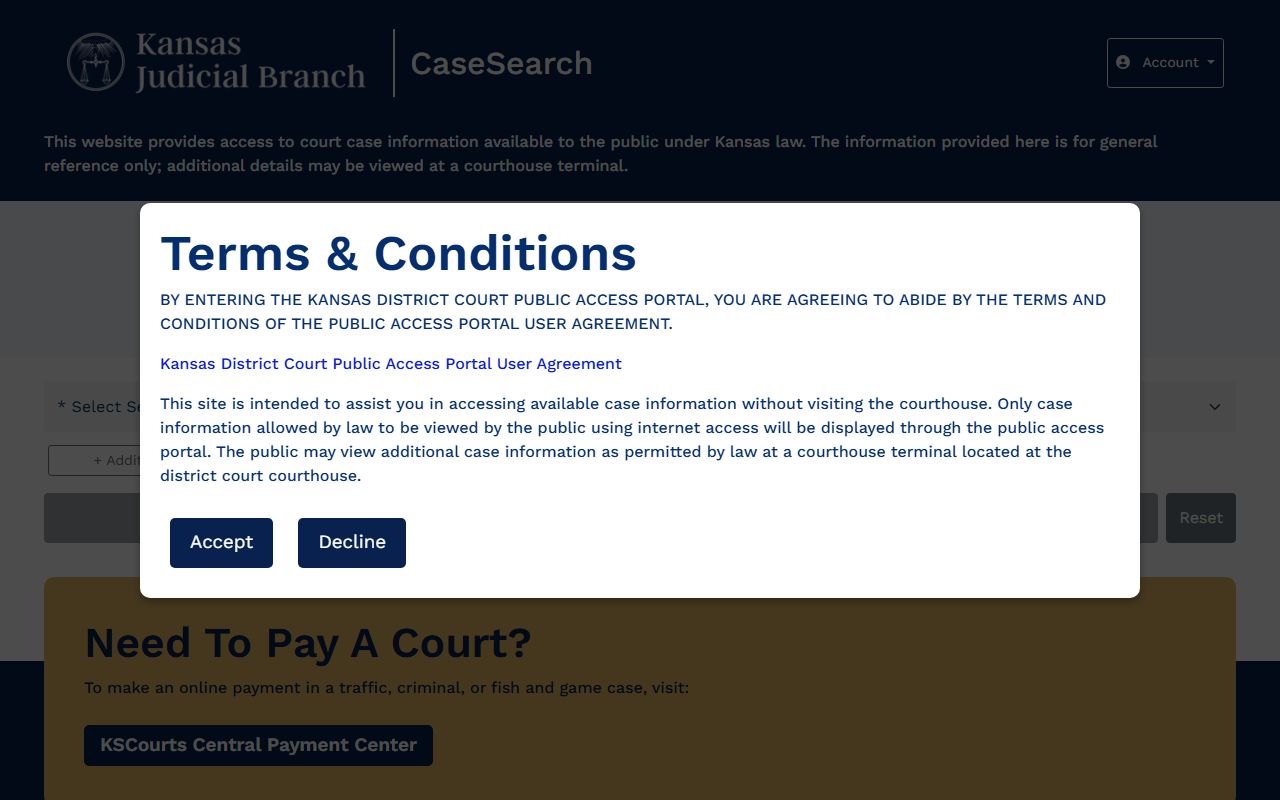
CaseSearch helps connect a Mitchell County arrest to the filed case, but it does not replace the jail phone line for live custody status.
| Field Label | Type | Required | Notes |
|---|---|---|---|
| Case number | Text | Optional depending search path | Use the exact case number if known. |
| Party name | Text | Optional depending search path | Use defendant or person search after a jail arrest. |
| Business name | Text | Optional | For entities, not most criminal defendant searches. |
| Citation | Text | Optional | Useful for traffic or municipal citations. |
| Role or criteria | Portal controls | Varies | Search criteria can depend on the user's role and portal controls. |
| Search or submit | Button | n/a | Runs the selected search. |
Find Court Records After Arrest
The cleanest workflow starts with custody and then moves to the court record. If the person was just booked, call Mitchell County Jail first. If the case has been filed, search Kansas CaseSearch by party name or case number. If CaseSearch does not show a result and the arrest is recent, the prosecutor may not have filed yet, or the public portal may not show the record in the way expected.
- Confirm recent custody or release with Mitchell County Jail if the arrest is fresh.
- Allow for filing time if no court record appears yet, especially when bond information exists before a formal case is visible.
- Search Kansas CaseSearch by defendant name, case number, or citation when one is known.
- Open the case result and review charge entries, hearing dates, warrants, bond, and disposition fields when available.
- Call or visit the Mitchell County District Court Clerk at 115 S Hersey if the public portal does not answer the case-status question.
For broad criminal-history searches, use the Kansas Bureau of Investigation criminal-history route referenced by KDOC rather than relying only on a jail booking or one court docket. A single Mitchell County court record after an arrest is a case file, not a full statewide criminal-history report.
Mitchell County Charging Documents
A charging document is the written filing that turns an arrest into a court case. In Mitchell County, the County Attorney is the local prosecutor for county criminal cases. Research did not locate a local prosecutor biography page, so use the official county directory and the county commission minutes for the office and name. The charging document may not match every word used at booking because the prosecutor reviews the arrest facts before filing.
| Document | Who files or issues it | What it does | Mitchell County use |
|---|---|---|---|
| Complaint | Prosecutor, often based on law-enforcement facts | Starts a criminal case by alleging an offense. | Common source for the first filed charge after arrest. |
| Information | Prosecutor | States formal charges after prosecutor review. | Can replace, refine, or continue earlier charge allegations. |
| Indictment | Grand jury | Charges an offense through grand jury action. | Less routine than complaint or information, but still a charging-document type. |
Mitchell County Charge Status
Charge status tells where a specific accusation stands inside the court record after a jail arrest. A charge can remain pending, be amended, be reduced, be dismissed, or end in a plea, trial finding, diversion result, or other disposition. A dismissed charge is not a conviction. A pending charge is not proof that the person committed the offense. Always read the latest docket entry and disposition, not just the first charge label.
| Status | What it means | Where to verify |
|---|---|---|
| Pending | The accusation is active and has not reached final disposition. | CaseSearch or District Court Clerk. |
| Amended | The prosecutor or court record changed the charge wording, level, or count. | Later charging document and docket entries. |
| Reduced | The charge was lowered to a lesser offense or level. | Disposition and plea entries. |
| Dismissed | The charge did not result in a conviction on that count. | Dismissal order or docket disposition. |
| Convicted | The case ended in a guilty plea, verdict, or other conviction result. | Judgment, sentence, or disposition entry. |
Bond After Mitchell County Arrest
Bond is often the first court-related issue after a jail arrest. Mitchell County's official bonding page gives local rules. For in-county inmates, if bond has been set, the jail says every effort will be made to allow the inmate to arrange bond. For a cash/surety bond, the person posting bond must pay ten percent of the bond amount in cash only unless arrangements are made directly with a bonding agent. For cash-only bond, the adult offender must pay the full amount in exact cash.
The Mitchell County Jail bonding page explains why a felony arrest may not show an immediate bond amount.
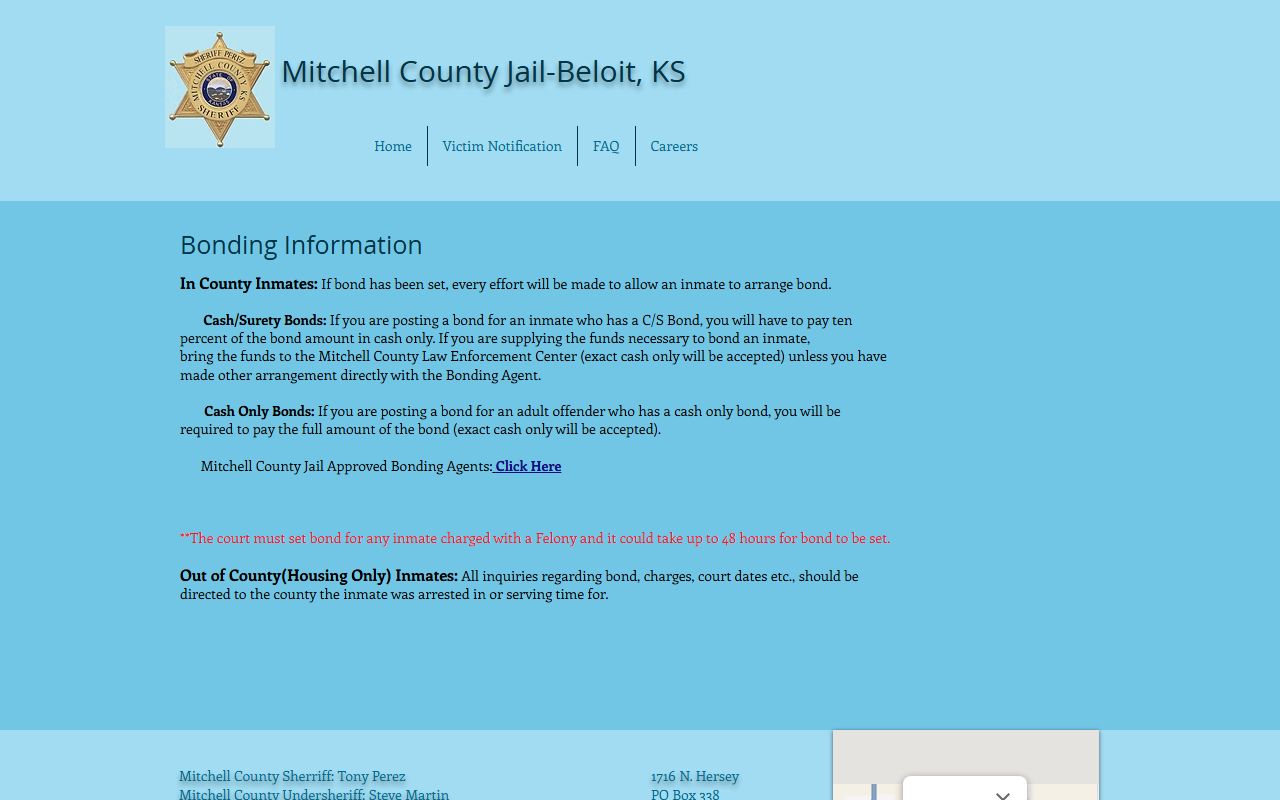
That local bonding rule helps explain the timing gap between booking, court bond setting, and the first visible court record after a Mitchell County arrest.
| Bond type | Mitchell County meaning | Where to verify |
|---|---|---|
| Cash/surety | Jail page says ten percent in cash only unless arranged with a bonding agent. | Jail, bonding agent, court. |
| Cash only | Full bond amount due in exact cash. | Jail or court. |
| Felony bond pending | The court must set felony bond, and Mitchell County says it may take up to 48 hours. | Court and jail. |
| Out-of-county housing | Mitchell may only house the person, while the original county controls bond and court dates. | Arresting or sentencing county. |
| Hold or detainer | Another agency may keep custody active even after a local bond issue is addressed. | Jail plus holding agency. |
Mitchell County Warrant Fallbacks
No official Mitchell County active warrant search was located. That means warrant questions should be routed through official offices rather than a public warrant portal. Call the Sheriff's Office or jail at 785-738-3523 to ask whether active warrant confirmation is provided by phone and what identification is required. For bench warrants tied to a court case, contact the Mitchell County District Court Clerk. For a warrant entry tied to a filed case, Kansas CaseSearch may show useful court events.
The county communications research matters here because Mitchell County Communications handles administrative calls for the Sheriff's Department and Jail, Beloit Police, and the probation office, and it enters wanted people, sex offenders, stolen property, and protection-from-abuse orders into NCIC. Dispatch and administrative routing do not create a public online warrant list, but they explain why a caller may be routed through law enforcement rather than court staff.
Charges Versus Convictions
Court records after a jail arrest can show allegations before any final finding. A charge is a claim filed in court. A conviction is a final result based on a plea, verdict, or other conviction event. This difference is critical when reading Mitchell County court records because a booking label, complaint count, or pending charge should not be described as a conviction unless the case record shows that result.
| Issue | Charge | Conviction |
|---|---|---|
| Stage | Accusation filed or pending in court. | Final guilt result by plea, verdict, or judgment. |
| Proof level | Based on filing standards and probable cause. | Requires a conviction result in the case record. |
| Can change | May be amended, reduced, added, or dismissed. | Changes only through later court action, appeal, or record relief. |
| How to read it | Check current status and latest docket event. | Check judgment, sentencing, and final disposition. |
Sealed and Expunged Records
Kansas law includes arrest-record expungement. K.S.A. 22-2410 allows eligible people arrested in Kansas to petition district court for expungement of an arrest record. The effect and public visibility of a record depend on the statute, the court order, and the record holder. A public search result may be limited by sealing, expungement, juvenile rules, privacy limits, or KORA exceptions.
| Issue | Sealed | Expunged |
|---|---|---|
| Public view | Hidden or restricted from ordinary public access. | Treated under the expungement order and statute for eligible arrest records. |
| Record still exists | Usually retained with restricted access. | Handled under the court's expungement order and Kansas law. |
| How to request | Through the court process that applies to that record. | Petition the district court when eligible under K.S.A. 22-2410. |
| Best office | District Court Clerk for court-file access questions. | District Court Clerk for filing and case-status questions. |
Note: K.S.A. 45-221 can also limit access to records with investigation, privacy, medical, or other protected content.
Record Access Limits
Public court and jail records are not the same as unrestricted background reports. K.S.A. 45-215 titles the Kansas Open Records Act. K.S.A. 45-218 says public records are open for inspection unless another law provides otherwise. K.S.A. 45-221 lists exceptions. K.S.A. 45-230 restricts use of names and addresses from public records for solicitation, and Mitchell County's KORA form requires that certification.
For court records after a jail arrest, use the office that holds the record. Custody status belongs first to the jail. Filed case records belong to CaseSearch or the court clerk. Charging decisions belong to the County Attorney once filed in court. Sentenced prison status belongs to KDOC KASPER. A Mitchell County court record should not be used as a complete criminal-history report or a consumer report for credit, employment, tenant screening, insurance, or any other FCRA-covered decision.